How a drop is made

Most ideas never survive it. Here is the whole thing, including a real drop taken apart line by line.

Three tests

Every idea has to pass all three. Most pass one, a few pass two, and only the ones that pass all three ever reach you.

1

Is it true?

Checked against two credible sources, as close to the original research as we can get. A fact that only survives in retellings does not go out, however good it sounds.

2

Is it surprising?

It has to tell you something you did not already know, or change something you thought you did. A pleasant fact everyone has heard does not earn a place in your morning.

3

Does it hold in two minutes?

Some subjects need an hour to do properly. If we cannot explain it honestly in the space we have, we leave it alone rather than flatten it.

The process

1

Finding it

Ideas come from reading widely and following footnotes. The best ones usually arrive sideways: a detail mentioned in passing, a claim that sounds wrong, a question nobody seems to have answered.

The test at this stage is simple. Did it make us stop reading and look something up?

2

Standing it up

Then we try to prove it wrong. Two credible sources, as close to the original research as we can get. A lot of the most charming facts in circulation collapse at this point.

If it cannot be stood up, it does not go out. There is no version of a drop that is probably true.

3

Writing it

A drop runs to about two hundred words. You get the fact straight away, then enough evidence to believe it. Nothing is stretched to fill space.

Everything that can be cut is cut. Two minutes is a promise, not an estimate.

4

Why it matters

The hardest part, and the reason we started. A fact on its own is trivia. The last lines give it perspective, and that is usually the part that stays with you.

If we cannot find that connection, the drop is not finished, however good the fact is.

5

The picture

Every image is made for the story it sits with, chosen for what it says rather than what it shows. Some have a joke in them. Some have an easter egg. None of them are decoration.

A picture that makes you look twice is doing as much work as the words.

6

The last read

One final question before it goes out: would we send this to a friend unprompted? If the answer is anything short of yes, it goes back in the pile.

One drop, taken apart

This went out on a Wednesday, under History & Culture. Here it is with the working shown.
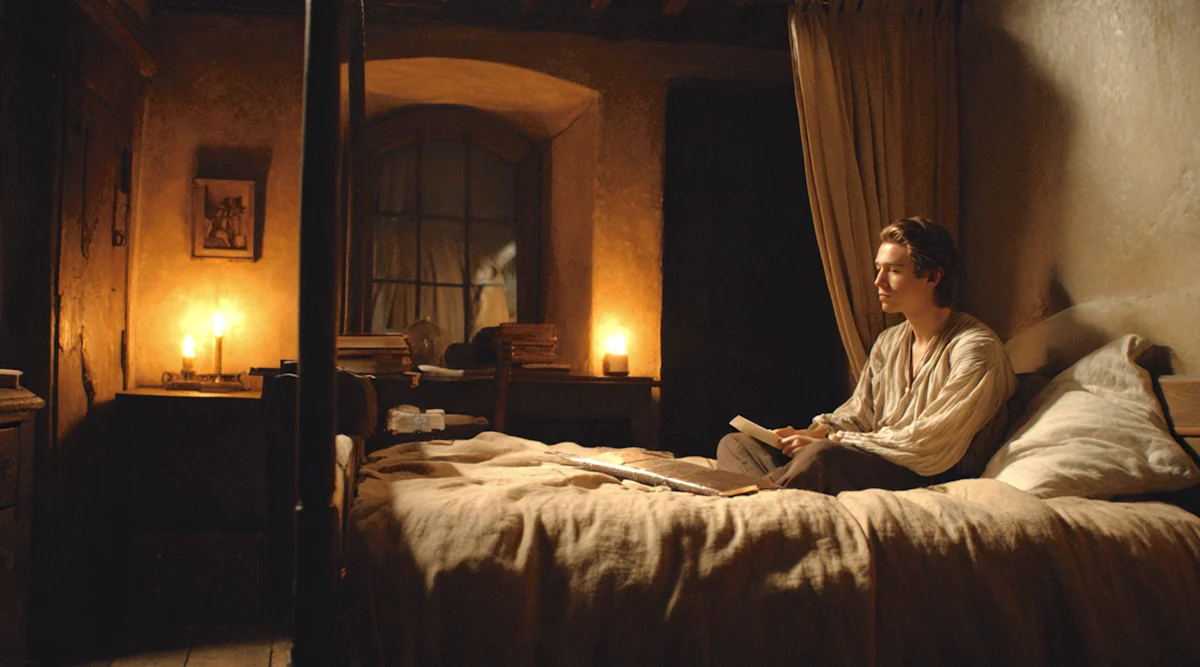
A candlelit bedroom in the middle of the night

History & Culture

We used to sleep in two shifts.

The headline tells you the fact. You open it to find out why.

Before electricity, people didn't sleep in one long stretch.

The claim, straight away, so you know what you are reading about.

For centuries across Europe, especially from the Middle Ages to the early 1800s, it was normal to sleep in two parts. People went to bed after dark, slept for a few hours, then naturally woke around midnight for an hour or two before drifting into a "second sleep."

The evidence, with places and dates, so you can believe it.

This in-between time was often used for prayer, reading, sex, reflection and even visiting neighbours. It was seen as a calm, reflective break before returning to bed.

The detail that makes it real: what people actually did in those hours.

The pattern faded in the 19th century, with the rise of streetlights, factories, and strict work hours.

Why it ended, so the whole thing makes sense.

Some researchers suggest that brief waking at night may not always signal insomnia, but echo an older pattern of human sleep.

Careful wording. The research is unsettled, and the sentence says so.

Waking up at night can feel like failure in a culture obsessed with uninterrupted sleep. But for much of history, it was simply part of the night. Reframing it as a natural pause for quiet, mindful activity can ease the pressure to sleep without waking.

The part that turns a fact about the past into something about you.

What doesn't make it

Roughly speaking, ideas die in four ways.

It isn't quite true. The version everyone repeats turns out to be a simplification, or a single study nobody could replicate.
Everybody knows it. True, tidy, and no use to you. If it has been on a mug, it has been on a mug.
It needs an hour. Genuinely fascinating, genuinely unexplainable in two minutes without lying by omission.
There is no why. A fact that connects to nothing. Interesting for a moment, forgotten by the time you put the phone down.
Back to About Didu